IASO is an innovative, open-source, bilingual (EN/FR) data collection platform with advanced geospatial features to plan, monitor and evaluate health, environmental or social programmes in low- and middle-income settings (LMICs). IASO is recognized as a Digital Public Good by the Digital Public Good Alliance and listed as a Digital Square Software Global Good, a testament to its proven impact.
IASO’s core functionalities revolve around four interconnected components, each reinforcing the capabilities of the others:
IASO allows the tracking of entities, which can be individuals (e.g., health or social program beneficiaries) or physical objects (e.g., supplies, parcels, bed nets). Workflows facilitate entity tracking by linking forms dynamically based on previous responses.
IASO’s flexible and scalable architecture makes it a powerful solution for organizations seeking to improve data-driven decision-making and operational efficiency.
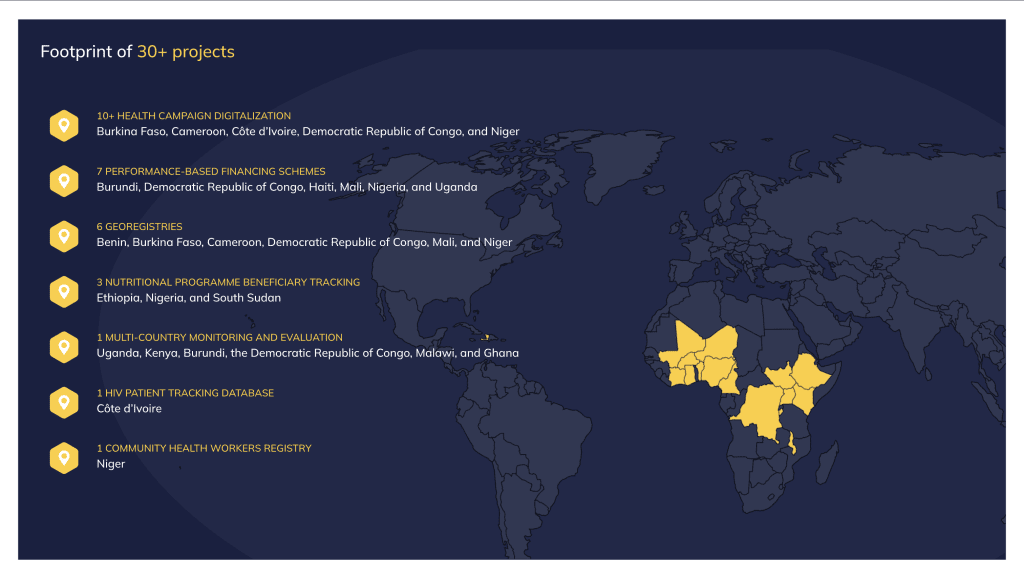
IASO has been implemented in Benin, Burkina Faso, Burundi, Cameroon, the Central African Republic, the Democratic Republic of Congo, Ethiopia, Haiti, Ivory Coast, Mali, Niger, Nigeria, Senegal, South Sudan, and Uganda. It has been instrumental in updating geographic data in the Democratic Republic of Congo, Côte d’Ivoire, and Burkina Faso, where it also serves as the official georegistry. At the regional level, IASO supports the Global Polio Eradication Initiative in the AFRO region, providing robust geospatial and health facility registry capabilities.
With its advanced geospatial features, IASO is a leading solution for geo-enabled campaign digitalization, enabling precise planning, monitoring, and execution of critical health interventions. Whether for vaccination campaigns (measles, polio, yellow fever, etc.) or the distribution of essential health items (bed nets, seasonal malaria chemoprevention, etc.), IASO ensures efficient targeting and optimized resource allocation.
More recently, IASO has been supporting the digitalization of a United Nations nutrition program for children under five and pregnant and breastfeeding women, with plans for expansion to multiple countries. Its adaptability and scalability make it a powerful tool for tracking individuals and resources in various contexts, including monitoring community health workers and managing logistics. By providing real-time, high-quality data, IASO enhances decision-making, improves coordination, and ensures that interventions reach those who need them most.